Welcome!

Please Read the General Instructions First before Browsing to the Pre-lecture pages.

thanks..


INTRODUCTION to MYOCARDIAL INFARCTION

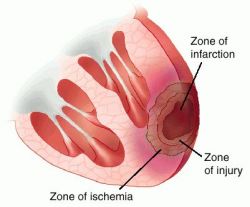
Myocardial infarction (MI) is the rapid development of myocardial necrosis caused by a critical imbalance between oxygen supply and demand of the myocardium. This usually results from plaque rupture with thrombus formation in a coronary vessel, resulting in an acute reduction of blood supply to a portion of the myocardium.

MI is a leading cause of morbidity and mortality in the United States. Approximately 1.3 million cases of nonfatal MI are reported each year, for an annual incidence rate of approximately 600 cases per 100,000 people. The proportion of patients diagnosed with NSTEMI compared with STEMI has progressively increased.

Cardiovascular diseases account for 12 million deaths annually worldwide. MI continues to be a significant problem in industrialized countries and is becoming an increasingly significant problem in developing countries.
Incidence of myocardial infarction is highest in ages more greater than 40 years old. A male predilection exists in persons aged 40-70 years. Evidence exists that women more often have MIs without atypical symptoms. The atypical presentation in women might explain the sometimes delayed diagnosis of MIs in women.Approximately 500,000-700,000 deaths are caused by ischemic heart disease annually in the United States.
One third of patients who experience STEMI die within 24 hours of the onset of ischemia, and many of the survivors experience significant morbidity. For many patients, the first manifestation of coronary artery disease is sudden death likely from malignant ventricular dysrhythmia.

More than one half of deaths occur in the prehospital setting. In-hospital fatalities account for 10% of all deaths. An additional 10% of deaths occur in the first year postinfarction. A steady decline has occurred in the mortality rate from STEMI over the last several decades. This appears to be due to a combination of a fall in the incidence of MI (replaced in part by an increase in the incidence of unstable angina) and a reduction in the case-fatality rate once an MI has occurred.

CAUSES of MYOCARDIAL INFARCTION

MI is usually caused by reduced blood flow in a coronary artery due to atherosclerosis and occlusion of an artery by an embolus or thrombus.

Other causes of MI include:
vasospasm (sudden constriction or narrowing) of a coronary artery
decreased oxygen supply ( e.g, from acute blood loss, anemia or low blood pressure)
increased demand for oxygen (e.g, from a rapid heart rate, thyrotoxicosis, or ingestion of cocaine)

In each case, a profound imbalance exists between myocardial oxygen supply and demand

Risk factors for atherosclerosis are also generally risk factors for myocardial infarction:
>
Older age

> Male sex
> Tobacco smoking
> Hypercholesterolemia (more accurately hyperlipoproteinemia, especially high low density lipoprotein and low high density lipoprotein)
> Hyperhomocysteinemia (high homocysteine, a toxic blood amino acid that is elevated when intakes of vitamins B2, B6, B12 and folic acid are insufficient)
> Diabetes (with or without insulin resistance)
> High blood pressure
> Obesity (defined by a body mass index of more than 30 kg/m², or alternatively by waist circumference or waist-hip ratio).
> Stress Occupations with high stress index are known to have susceptibility for atherosclerosis.
> Socioeconomic factors such as a shorter education and lower income (particularly in women), and living with a partner may also contribute to the risk of MI.

Signs and Symptoms of Myocardial Infarction

please click this URL below for the signs and symptoms of myocardial infarction

http://www.youtube.com/watch?v=hgiCoBg560c


Assessment and Findings
Diagnosis of MI is generally based on the presenting symptoms, the ECG and laboratory test results. The prognosis depends on the severity of coronary artery obstruction and the extent of myocardial damage. Physical examination is alone is insufficient to confirm the diagnosis.

Patient History
The patient history has two parts: the description of the presenting symptoms (e.g., pain) and the previous history should also include information about the patient’s risk factors for the heart disease.

Electrocardiogram
The ECG provides the information that assists in diagnosis of acute MI. it should be obtain 10 minutes from the time a patient reports pain or arrives in the emergency department. By monitoring the ECG over time, location, evolution, and resolution of an MI can be identified and monitored. The classic ECG changes are T-wave inversion, ST-segment elevation, and development of an abnormal Q-wave.

Echocardiogram
The echocardiogram is used to evaluate ventricular function. It may be used to assist in diagnosing MI, especially when the ECG is nondiagnostic. It can detect hypokinetic and akinetic wall motion and can determine the ejection fraction.

Laboratory tests
Creatinine Kinase and its isoenzymes. There are three CK isoenzymes: CK-MM ( skeletal muscle), CK-MB (heart muscle), CK-BB ( brain tissue). CK-MB is the cardiac-specific, found mainly in cardiac cells and only rises when there has been damage. It is the most specific index for diagnosis of MI. The level started to increase a few hours and peaks within 24 hours of an MI. if the areas is reperfused , it peaks earlier.
Myoglobin. Myoglobin is a heme protein that helps to transport oxygen. Myoglobin is also found in the cardiac and skeletal muscles. The myoglobin level starts to rise within 1 to 3 hours and peaks within 12 hours after the onset of symptoms. It is not a specific indicator of acute MI; however, it can be an excellent parameter of ruling out an acute MI.
Troponin. Troponin, a protein found in myocardium, regulates the myocardial contractile process. There are three isomers of troponin (C, I, T). Because of the smaller size of the protein and the increased specificity of troponin I and T for cardiac muscle, these tests are used more frequently to identify myocardial injury. The increase in the level of troponin in the serum starts and peaks at approximately the same time as CK-MB. However, it remains elevated for a longer period often up to 3 weeks, and therefore cannot be used to identify subsequent extension or expansion of an MI.

Medical Management
The goal of medical management is to minimize myocardial damage, preserve myocardial function, and prevent complications.

Pharmacological therapy
Thrombolytics: Streptokinase
Prupose: to dissolve and lyse the thrombus in a coronary artery, allowing blood to flow through the coronary artery again (reperfusion), minimizing the size of infarction and preserving ventricular function.
Analgesics: Morphine Sulfate
Purpose: reduce pain and anxiety. It produces preload, which decreases the workload of the heart. It also relaxes bronchiole to enhance oxygenation.

Angiotensin-Converting Enzymes Inhibitors (ACE-I)
Purpose: prevent conversion of angiotensin I to II. In the absence of angio-II, the blood pressure decreases and the kidneys excrete sodium and fluid, decreasing the oxygen demand of the heart.

Emergent Percutaneous Coronary Intervention (PCI)
PCI may be used to open the occluded coronary artery in an acute MI and promotes reperfusion to the area that has been deprived of oxygen. Because the duration of oxygen deprivation is directly related to the number of cells that die, the time from the patient’s arrival in the emergency department to the time PCI I s performed should be less than 60 minutes.

Nursing management
Nursing diagnosis:
· Ineffective cardiopulmonary tissue perfusion related to reduced coronary blood flow from coronary thrombus and atherosclerotic plaque
· Potential impaired gas exchange related to fluid overload from left ventricular dysfunction
· Potential altered peripheral tissue perfusion related to decreased cardiac output from left dysfunction
· Anxiety related to feeling of impending doom
· Deficient knowledge about post MI self-care


Nursing interventions:
1. Develop a trusting and caring relationship to reduce anxiety
2. Relieving pain and other signs and symptoms of ischemia
3. Oxygen administration. Flow rate of 2-4L/min
4. Vital signs and record accordingly
5. Physical bed rest with backrest elevated
6. Ensuring a quiet environment, prevent interruptions that disturb rest
7. Monitor potential complications

Source: Smeltzer, Suzanne, et al. Brunner and Suddarth’s Textbook of Medical Surgical Nursing, 10th edition. USA: Lippincott Williams and Wilkins. 2004. P276

REVIEW of the ANATOMY and PHYSIOLOGY of the HEART
for more comprehensive site, please click this URL for the full review about the anatomy and physiology of the Heart

http://butler.cc.tut.fi/~malmivuo/bem/bembook/06/06.htm
http://www.hhmi.org/biointeractive/vlabs/cardiology/content/cg/basic.html

DISTANCE LEARNING

Distance Learning

Definition:

It is a learning strategy that utilizes multimedia methods to connect teachers and learners who are geographically separated.

Advantage:
People in rural areas or those who are homebound can have greater access to information and even educational degrees.
Learners who used to have to travel several hours to attend courses or educational sessions can now receive the information in their homes or at a local site.
Accessibility of a larger variety of courses
Self-directed nature of the learning experience
Opportunity to learn more about technology

Disadvantage:
Lack of face-to-face contact with the teacher
Possibility of having technology glitches which may be as severe as the system’s shutting down and being inaccessible
Learners may not be able to access the hardware and software they need.
Some may struggle with learning to use the technology at the same time they are supposed to be learning contents.
Some may not learn well with less structure in the educational experience.
Some may experience alienation.

Two Types of Technology Utilized:

Television-based
A typical television classroom contains a teaching podium with a control panel for the cameras and monitors, a microphone for the teacher, a computer hook-up, a document camera and a fax machine.
There are variations of equipment, but in most configurations, the plan is to allow each teaching or learning site to be visible and heard and to allow maximum interaction between teacher and students and between students to students. Each remote site is similarly equipped, so transmission can occur from any site.

Internet-based
Classes that is delivered via the Internet and the World Wide Web.
Such courses are expanding exponentially as academia, business and health care organizations are all getting into the business of distance learning and believed that online courses can be cost effective.

Television-based classes
Class management
It is desirable to either mail course materials to all students before the first calls or to have materials available on a course Web site. Single handouts can be faxed to remote sites at the beginning of class sessions if there is convenient copying capability in the remote sites.
Examinations require logistic planning. In-class written examinations must be prepared well in advance so they can be mailed to the remote sites, stored in a safe place, and distributed during the class. Often, in class, open-book tests are given or take-home tests are used.
Classes should be videotaped so that if the home-site class continues after technological failure, the remote sites can play the video later.
There must be a proctor available at all times and the presence of a technician during the broadcast times is generally considered essential.
Current patrons
Majority of the users come from colleges and universities.
However, large hospitals, medical centers, and health maintenance organizations are also using ITV classrooms for staff development. Hospital conglomerates and consortiums can maximize the efficiency of some staff development programs by sending them to several sites at one time.

Internet-based classes
Synchronous versus Asynchronous
Synchronous online learning occurs when people interact in real time electronically via the Internet or intranet. Much more common are asynchronous applications in which materials are located on a web page that can be accessed at any time at the learners’ convenience. Whether classes are synchronous or asynchronous, the role of the teacher is to guide the learners and keep them on track, while providing support and motivation.
Advantage and Disadvantage of Online Courses
Advantages:
Greater access
More convenient
High availability
Promotes active learning
Promotes independence, time management and self-discipline
Disadvantages
It cannot substitute for the full, rich experience of the classroom
Visual cues (body language and expression) and their meaning in written discussion

become absent.
Immediate clarification and feedback is not available.
Unavailability of technology to some learners
Older learners lack the literacy skills
Valuable course time may be lost while people try to learn rudiments of skill
Academic faculty who have had experience with learning online courses spend more time

on teaching traditional courses
Written e-mail messages may take longer than would a face-to-face conversation in the

classroom and technology glitches may also add to faculty workload.
Web-enhanced courses
A special blend of traditional and online education

May be either of the two:
A course may be primarily online, but students may be asked to come to classes or

seminars on campus two to three times during the semester.
A course may be primarily on-campus, but some work is done online throughout the

semester.
New ways of using the Internet or telecommunications for education are still evolving. It is

important for educators to keep abreast of changing technology and its potential for
learning purposes.

Current patron
Presently, most distance education online is taking place in colleges and universities. They are producing courses for undergraduates and graduate students, with special emphasis on BSN to RN programs and advance practice graduate programs.
Many universities and for profit companies are also developing continuing education courses for nurses. A quick search of the Internet will reveal myriad courses for professional development in many specialties.

GROUPINGS

Group One
Instructor: Dasalla
Leader: Aala
Members:
Balagtas, R.
Camello
Diaz
Hao
Lugtu
Perez
Emma*


Group Two
Instructor: Manuntag
Leader: Pinili
Members:
Amoroso
Bisnar
Co
Echavez
Lomongo
Magdoboy
Wee

Group Three
Facilitator: Nierra
Leader: Llanes
Members:
Apostol
Buya
Colendres
Elorde
Niez
Sabella
Yap

Group Four
Facilitator: Torrijos
Leader: Teh
Members:
Badilles
Cadiatan
Cruzada
Gualta
Lopez
Pacifico

Group Five
Facilitator: Cayunda
Leader: Valdez
Members:
Balagtas, D.
Cagoco
De Castro
Gulles
Lozada
Pasion

GENERAL INSTRUCTIONS in TAKING the QUIZ

general instructions:
  • IN BROWSING FOR PRE-LECTURES on MYOCARDIAL INFARCTION, this SITE is available from 7am - 10pm Starting AUGUST 18 - 20, 2008
  • ALL GROUP MUST SET A COMMON TIME AVAILABILTY in BROWSING THE PRE-LECTURES
  • EVALUATION or QUIZ must be placed in a MICROSOFT WORD format (save your file using your complete name, ex. RhyanBenDasalla.doc) and SEND IT BACK to US though this E-MAIL ADDRESS - clyde17_me@yahoo.com
  • DEADLINE of SUBMISSION of QUIZ WILL BE ON OR BEFORE AUGUST 20, 2008 @ 8PM. LATE PROCUREMENT WILL BE CONSIDERED ZERO.
to all group leader assignee:
PLEASE INFORM US WHEN WILL ALL OF YOU AS GROUP WILL BE AVAILABLE for GROUP DISCUSSION.

for group one: Rhyan Ben Dasalla
09228943251
rbpolgas_1xavier@yahoo.com

for group two: Krisette Manuntag
09268170980
kris_tet@yahoo.com

for group three: Marjorie Nierra
09234811497
marjori_fay@yahoo.com

for group four: Melissa Torrijos
09262101615
mel_ditz@yahoo.com.ph

for group five: Carlito Cayunda
09293809388
clyde17_me@yahoo.com

QUIZ

GENERAL INSTRUCTIONS:
  • Copy this quiz format and place it in Microsoft Word and Save the file using your full name (e.g. Rhyanbendasalla.doc) and send it back to us through this e-mail address - clyde17_me@yahoo.com
  • Submit the quiz on or before August 20, 2008 @ 8pm
  • Late procurement means zero.

- - - - - - - - - - - - - - - - - - - - - START COPY HERE- - - - - - - - - - - - - - - - - - - - -

Quiz 1

1-2 In your own words, describe what is myocardial infarction. Limit your answer within 5-10 sentences. Warning: Do not plagiarize.
3. Give two causes of myocardial infarction.
4. Give one diagnostic test.
5. Give one medical management.
6. Apply one nursing diagnosis that can be related to myocardial infarction.
7. Give one nursing intervention related to your diagnosis in no. 6.
8. Desrcibe distance learning. Limit your answer within 5-10 sentences. Warning: Do not plagiarize.
9-10. Give two methods in administering distance learning strategy. Compare the two methods in not more than 3 sentences. Warning: Do not plagiarize.
11. Name specific devices that can be utilized in each methods of distance learning strategy.
12-13. Enumerate at least 3 advantages of distance learning and relate experience to such.
14-15. Name at least 3 disadvantages of distance learning and relate experience to such.